From police cars to IoT sensors, whip antennas remain the most ubiquitous wireless solution in modern communications. This comprehensive guide explores their working principles, practical applications, and selection criteria—backed by field-tested data and industry standards.
A Whip Antenna is a monopole antenna named for its long, thin appearance resembling a whip. This antenna consists of a single upright metal conductor, typically mounted vertically on a conductive ground plane. According to IEEE Std 145-2013 (Antenna Terminology Standard), whip antennas belong to the monopole radiator category and are one of the most widely used antenna types in wireless communication systems.
Industry Applications: Whip antennas are widely used in vehicle-mounted communications, portable devices, and IoT applications, making them one of the most common antenna types in mobile communication systems.
Typical whip antennas present an elongated rod-like structure, with lengths typically ranging from a few centimeters to several meters, depending on the operating frequency. The antenna body can be a rigid metal rod or a flexible helical structure. The base is equipped with standard RF Connectors (such as SMA, BNC, or N-type interfaces) for easy connection to wireless devices. Many whip antennas feature telescopic designs, allowing length adjustment according to actual needs.
In antenna technology classification, whip antennas belong to the monopole antenna category and are variants of dipole antennas. Unlike dipole antennas that require two symmetrical radiating elements, whip antennas use only one radiating element, utilizing the ground plane to produce a mirror image effect to complete electromagnetic wave radiation. This design gives whip antennas significant advantages in space utilization and installation convenience.
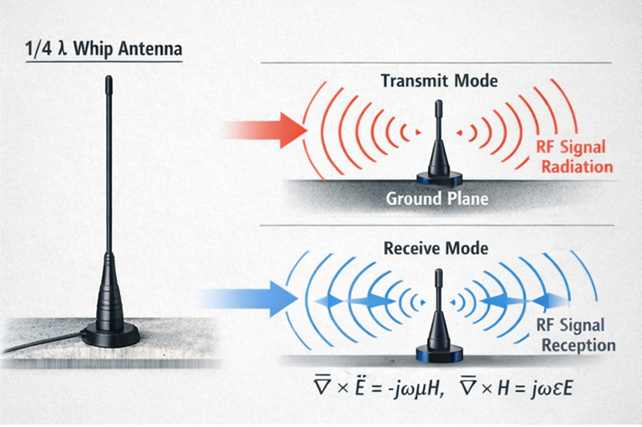
The working principle of whip antennas is based on monopole radiation theory, first experimentally verified by Heinrich Hertz in 1886. When RF current passes through the antenna element, an alternating current distribution is generated along the antenna length. These currents excite the electromagnetic field in the surrounding space, forming outward-propagating electromagnetic waves.
Based on electromagnetic field theory and Maxwell's equations, antenna length is typically designed to be 1/4, 3/8, or 5/8 times the operating wavelength to achieve resonance and optimal radiation efficiency. This classic resonance design principle is based on the λ=c/f relationship and is detailed in various antenna engineering textbooks and handbooks.
In transmit mode, the feedline transfers RF power to the antenna, which converts electrical energy into electromagnetic wave energy and radiates it into space. In receive mode, the process is reversed: space electromagnetic waves excite induced current in the antenna, which is transmitted through the feedline to the receiving equipment. The vertical polarization characteristic of whip antennas determines their highest reception efficiency for vertically polarized waves, making them particularly suitable for ground mobile communication applications.
The ground plane plays a critical role in the whip antenna system. An ideal ground plane produces a mirror image of the antenna, making the monopole antenna's radiation characteristics equivalent to a complete dipole antenna. This phenomenon is based on Image Theory, one of the fundamental principles of antenna engineering.
Engineering Experience: An adequate ground plane is critical to antenna efficiency. According to antenna engineering practice, when the ground plane size reaches a fraction of the wavelength (e.g., approaching the 1/4λ scale), performance typically improves significantly, while insufficient ground plane leads to obvious efficiency reduction, impedance mismatch, and pattern distortion. The specific efficiency improvement depends on multiple factors including ground plane size, shape, and antenna matching network, and should be determined by actual measurements.
The radiating element is the core component of the whip antenna, responsible for electromagnetic wave radiation and reception. This part is typically manufactured from metal materials with excellent conductivity, with length precisely designed to match the target operating frequency. The geometric shape of the radiating element can be cylindrical, conical, or helical, with different shapes corresponding to different electrical characteristics and mechanical strength requirements.
The feed system establishes the electrical connection between the antenna and wireless equipment, including the feed point, matching network, and transmission line. The position of the feed point affects the antenna's input impedance. Many commercial whip antennas have built-in matching networks that convert the antenna's natural impedance to the standard 50 ohms to achieve good matching with mainstream RF equipment and minimize signal reflection loss.
The base provides mechanical support and electrical connection functions. High-quality base design includes waterproof sealing, anti-vibration structure, and reliable ground contact. Common connector types include SMA (for small devices), BNC (for quick connection scenarios), and N-type connectors (for high-power applications). Connector selection should consider frequency range, power handling capability, and environmental adaptability.
Stainless Steel (304/316 grade): Features excellent corrosion resistance and mechanical strength, complies with ASTM A240 standard, suitable for outdoor and marine environments (salt spray test >1000 hours), and is a common material for vehicle-mounted and fixed station antennas.
Copper or Copper Alloy: Conductivity reaches 100% IACS (International Annealed Copper Standard), offering the best electrical conductivity. Commonly used for radiating elements in high-performance antennas, but requires nickel or silver plating to prevent oxidation.
Aluminum Alloy (6061/7075): Weight is only 1/3 that of copper, with moderate cost. After anodization treatment (MIL-A-8625 standard), it has good weather resistance and is widely used in portable and lightweight applications.
Fiberglass/Carbon Fiber: Commonly used for outer protective layers (radomes), providing insulation protection and mechanical strength. Quality radome materials have dielectric constant εr ≈ 4.0-4.8 and loss tangent tanδ < 0.02, with minimal impact on RF performance. Materials must meet corresponding mechanical strength and environmental tolerance standards.
Rigid Whip Antennas use hard metal rod structures, maintain fixed shapes, and have stable electrical performance and high mechanical strength. These antennas are suitable for fixed installation scenarios such as base stations, vehicle roofs, or building exterior walls.
Flexible Whip Antennas use helical or rubber-coated structures that can bend without breaking. This design enhances portability and safety, particularly suitable for handheld devices and environments prone to impacts. Flexible designs sacrifice some electrical performance but provide better durability in practical applications.
Fixed Antennas have constant length, are optimized for specific frequencies, provide optimal performance and reliability, and are commonly used in professional communication equipment.
Telescopic Antennas allow users to adjust length, balancing portability and performance. They are compact when retracted for carrying and storage, and achieve optimal reception when extended. This design is widely used in portable radios, walkie-talkies, and emergency communication equipment.
Single-Band Antennas are optimized for specific frequency ranges, providing highest efficiency and best matching within the target band.
Multi-Band Antennas achieve multiple frequency band coverage through loading coils, segmented design, or broadband matching techniques. Although performance in each band may be slightly lower than dedicated single-band antennas, they significantly improve device flexibility and versatility, particularly suitable for applications requiring support for multiple communication standards.
Short Whip Antennas (length less than 1/4 wavelength): Compact size but require loading coils to achieve resonance, with relatively lower efficiency. Suitable for space-constrained portable devices.
1/4 Wavelength Antennas: The most classic design, achieving good impedance matching and omnidirectional radiation characteristics on suitable ground planes. The standard choice for vehicle-mounted and mobile applications.
5/8 Wavelength Antennas: By lowering the elevation angle, they may achieve certain gain advantages in ground communication scenarios (typically about 1-3 dB, depending on ground plane quality, installation height, and matching network), concentrating more energy in the horizontal direction. Suitable for long-distance ground communication. Requires a matching network to achieve 50-ohm input impedance.
Simple Structure, Low Cost: The design and manufacturing process of whip antennas is relatively simple, requiring no complex feed networks or precision machining equipment, making them one of the most economical antenna solutions. Mass production further reduces unit costs.
Omnidirectional Radiation Characteristics: In the horizontal plane, whip antennas exhibit omnidirectional or near-omnidirectional radiation patterns, capable of uniformly transmitting and receiving signals in all directions. This characteristic is critical for mobile communications, as the relative orientation of transmitters and receivers frequently changes.
Easy Installation: Standardized connector interfaces and simple mechanical structures make installation quick and convenient. In most cases, simply screwing the antenna into the corresponding interface completes installation, requiring no professional tools or complex tuning procedures.
Compact Size: Compared to array antennas, parabolic antennas, and other types, whip antennas occupy minimal space and do not significantly affect device appearance or vehicle aerodynamic performance. This advantage is particularly important in space-constrained applications.
Relatively Low Gain: Basic 1/4 wavelength whip antennas typically have gains in the 0-3dBi range, far lower than directional antennas or array antennas. Although 5/8 wavelength designs can improve gain, they still cannot compare with high-gain directional antennas. Low gain means shorter communication distances at the same transmit power.
Sensitive to Installation Location: Whip antenna performance strongly depends on installation location and surrounding environment. Nearby metal objects change radiation patterns, create blind spots, or cause impedance mismatch. For vehicle installations, antenna position (center of roof vs. trunk lid) significantly affects coverage uniformity.
Requires Good Ground Plane: Ground plane quality directly affects antenna efficiency. Inadequate ground plane leads to impedance mismatch, reduced radiation efficiency, and pattern distortion. Portable applications often cannot provide ideal ground planes, limiting full antenna performance.
Whip antennas are the standard configuration for vehicle radio systems. Police cars, taxis, buses, and logistics vehicles commonly use whip antennas for vehicle-mounted communications and dispatch.
Real Case: A city public security system adopted VHF band (150-174MHz) 1/4 wavelength whip antennas. After 3 years of usage testing, reliable communication distances of 8-12 kilometers were achieved in urban environments, with system availability reaching 99.7%. The vehicle metal body structure provided a good ground plane, while the roof center installation position ensured omnidirectional coverage with horizontal plane pattern circularity within 3dB.
Common bands include VHF (150-174MHz) and UHF (450-470MHz) professional mobile radio bands, complying with FCC Part 90 and ETSI EN 300 086 standards.
Handheld walkie-talkies, emergency communication equipment, and amateur radio portable stations widely use telescopic whip antennas or flexible rubber whip antennas. These antennas can withstand impacts and bending during daily use while providing acceptable communication distances within limited sizes. Search and rescue teams, event organizers, and construction site managers all rely on such equipment for instant communication.
Many wireless routers, access points, and network devices use external whip antennas to enhance signal coverage. Whip antennas for 2.4GHz and 5GHz bands are typically shorter (approximately 3-15 centimeters). Multiple antenna configurations implement MIMO technology, improving data transmission rates and reliability. Adjustable angle designs allow users to optimize coverage direction.
IoT sensors, remote monitoring devices, and smart meters widely use small whip antennas for data transmission.
Application Example: In a smart agriculture project, 868MHz (European ISM band) 1/4 wavelength whip antennas (length approximately 8.6cm) were used with LoRa modulation technology. In open terrain, measured communication distances reached 5-8 kilometers (transmit power 14dBm, receive sensitivity -137dBm). In NB-IoT application scenarios, optimized LTE Band 8 (900MHz) whip antennas achieved 2-3 kilometer coverage in urban environments.
These applications comply with 3GPP related UE RF specifications (E-UTRA series such as TS 36.101; specific NB-IoT clauses refer to corresponding 3GPP versions) and LoRa Alliance technical specification requirements. The antenna's compact size (typically<10cm) and low cost (consumer-grade bulk can reach several dollars or even lower, depending on structure and connector) characteristics perfectly align with IoT device design philosophy.
Vessels and aircraft use specially designed high-strength whip antennas for VHF maritime communications (156-174MHz) and aviation communications (118-137MHz).
These antennas typically need to meet more stringent environmental reliability requirements, such as:
Wind load resistance (aviation/maritime environments)
Salt spray corrosion testing (reference ASTM B117 and other standards)
Vibration testing (reference MIL-STD-810 series)
Wide temperature range operating capability
Applications must comply with ICAO Annex 10 (aviation standards) and IMO SOLAS (maritime safety convention) and other related requirements. High-performance products can use fiberglass shells (can achieve UL94 V-0 flame retardant rating) and 316 stainless steel radiating element combinations, with specific indicators based on application specifications and product data sheets.

Frequency is the primary consideration in antenna selection. The antenna must achieve resonance or good matching within the target operating band. Check the frequency range parameters in antenna specifications to ensure complete coverage of the required application bands. Broadband antennas provide greater flexibility, but performance at specific frequency points may be slightly inferior to narrowband dedicated antennas. For multi-band applications, select multi-band antennas that clearly support all target bands.
Outdoor Fixed Installation: Choose materials with strong weather resistance (stainless steel, anodized aluminum), equipped with waterproof connectors and anti-UV shells. Consider wind load and ice/snow adhesion issues, selecting antennas with appropriate mechanical strength.
Vehicle Mobile Installation: Prioritize low-profile designs to reduce wind resistance and damage risk. Magnetic bases or through-hole mounting methods each have advantages—the former facilitates temporary installation, the latter provides more stable connections.
Portable Handheld Applications: Flexible antennas provide optimal durability. Rubber shells protect internal radiating elements, extending service life. Weight and length should coordinate with overall device dimensions.
Indoor Applications: Can choose more refined appearance designs with relatively lower mechanical strength requirements, but need to note the impact of indoor metal structures on signals.
Gain directly affects communication distance and coverage range. For fixed point-to-point communications, higher gain (5-9dBi) 5/8 wavelength or collinear antennas can improve link performance. For mobile applications requiring omnidirectional coverage, standard 1/4 wavelength antennas (0-3dBi) are typically the best choice. Excessive gain concentrates radiation excessively in the horizontal direction, potentially creating blind spots at close range or in undulating terrain.
Confirm that the antenna connector matches the device interface. Common combinations include:
SMA Interface: Small devices, WiFi routers, GPS modules
BNC Interface: Handheld walkie-talkies, test equipment, legacy radio
N-Type Interface: Base station equipment, high-power applications, professional communication systems
UHF/PL-259 Interface: Amateur radio, CB radio, maritime equipment
Gender (male/female) also requires attention. High-quality adapters can be used when necessary, but each connector introduces small losses and should be avoided when possible.
Whip antenna prices span a wide range, from a few dollars for basic models to hundreds of dollars for professional products. Budget allocation should be based on actual needs:
Critical Communication Applications (safety, emergency, commercial dispatch) should invest in high-quality antennas to ensure reliability and optimal performance.
General Consumer Applications can select products with moderate cost-performance ratios, balancing cost and performance.
Experimental and Testing Purposes can use economical antennas, upgrading after system finalization.
Consider total cost of ownership, including antenna lifespan, replacement frequency, and maintenance needs. Although high-quality antennas have higher initial costs, they are more economical for long-term use.
Ensure the antenna base makes good contact with a conductive ground plane. For vehicle mounting, installation directly on the metal roof center position is most effective. If installed on non-metallic surfaces (such as fiberglass roofs), a metal ground plane must be added, typically consisting of 3-4 radially arranged metal strips, each approximately 1/4 wavelength in length. Ground plane connections must be secure—any looseness or corrosion will seriously reduce antenna performance.
When conditions permit, install the antenna at the highest possible position. Height increase brings two advantages: reduced obstruction by ground and surrounding objects, expanded line-of-sight communication range. Fixed station antenna ideal installation height should be higher than surrounding buildings and trees. Vehicle-mounted antennas installed on the roof center are superior to trunk or bumper positions. When using portable devices, avoid keeping the antenna close to the body and maintain vertical posture.
Metal objects in the antenna radiation path cause reflection, absorption, and pattern distortion. Installation location should be far from large metal structures, pipes, equipment cabinets, etc. For vehicle mounting, avoid obstruction by vehicle racks, luggage racks, or other additional equipment. Indoor installation should consider the impact of metal door and window frames and reinforced concrete walls. When necessary, optimize layout by changing antenna position or using extension cables.
The feedline (coaxial cable) connecting the antenna to equipment introduces loss, especially at high frequencies. Use quality low-loss cables suitable for the operating frequency, such as RG-58 (for short distances and lower frequencies), RG-8X or RG-213 (for longer distances and higher frequencies). Feedline length should be as short as possible, avoiding unnecessary routing. All connectors must be properly installed, ensuring integrity of center conductor, shield, and insulation. Regularly check connections for corrosion or looseness.
Outdoor installations must be properly waterproofed. Use antennas and connectors with IP65 or higher protection ratings. All joints should use self-adhesive sealing tape (such as 3M 2228) or heat-shrink tubing for sealing. Feedline entry points should be designed to bend downward forming a drip loop to prevent water from flowing along the cable into equipment.
For antennas with fixed building installations, implement lightning protection measures. Install RF surge arrestors (gas discharge tube or diode type) on feedlines, and antenna support poles should be well grounded. Although whip antenna heights are typically insufficient to become direct lightning strike targets, induced currents from nearby lightning strikes can still damage equipment.
How to calculate whip antenna length?
Basic formulas:
1/4 Wavelength Antenna: Length (meters) = 75 / Frequency (MHz)
5/8 Wavelength Antenna: Length (meters) = 187.5 / Frequency (MHz)
These formulas are derived from the speed of light c = 3×10⁸ m/s and the wavelength formula λ = c/f.
Calculation Examples:
150MHz VHF band: λ/4 = 75/150 = 0.5 meters (50 centimeters)
450MHz UHF band: λ/4 = 75/450 = 0.167 meters (16.7 centimeters)
2.4GHz WiFi: λ/4 = 75/2400 = 0.031 meters (3.1 centimeters)
Important Note: Actual products consider end effect and velocity factor (typically 0.95-0.97), so actual length is approximately 95% of theoretical value. Manufacturer specification dimensions already include these empirical corrections.
Why is a ground plane needed?
The ground plane produces an electrical mirror image of the antenna, making the monopole antenna behave like a complete dipole. Without a ground plane or with an inadequate ground plane, antenna impedance deviates from standard values (50 ohms), leading to high VSWR and efficiency reduction. The ground plane also affects radiation angle: a good ground plane concentrates more energy in the horizontal direction, increasing ground communication distance.
Can whip antennas be installed horizontally?
Technically feasible, but this changes polarization and radiation pattern. Horizontally installed whip antennas produce horizontal polarization waves. When communicating with standard vertical polarization systems, significant polarization loss occurs (theoretically reaching 10-30 dB magnitude, mitigated in actual environments due to multipath propagation). Additionally, horizontal installation weakens ground plane effects and worsens impedance matching. Unless special applications require horizontal polarization, maintain vertical installation.
How to test whip antenna performance?
Professional Testing Methods (compliant with IEEE Std 149 antenna measurement standards):
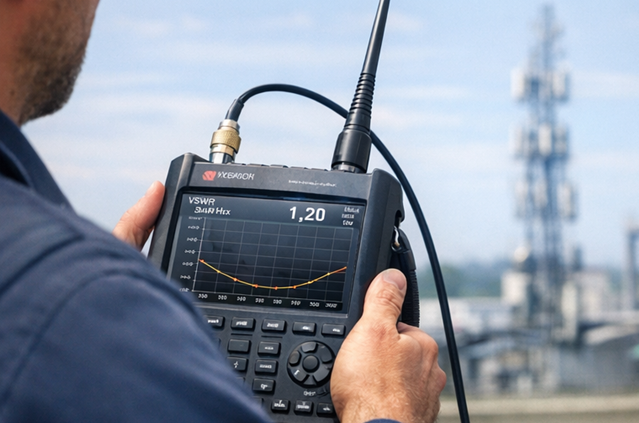
VSWR Measurement: Use Vector Network Analyzer (VNA) to measure VSWR and return loss
Excellent: VSWR < 1.5:1 (Return Loss > -14dB)
Good: VSWR < 2.0:1 (Return Loss > -9.5dB)
Acceptable: VSWR < 3.0:1 (Return Loss > -6dB)
Pattern Measurement: Measure radiation pattern in anechoic chamber or antenna test range (compliant with IEEE Std 149 measurement methods)
Gain Measurement: Use comparison method or three-antenna method (IEEE Std 149-1979 Method)
Field Simple Testing:
Use VSWR meter or built-in SWR test function
Compare signal strength meter readings (S-meter for relative reference only; IARU R.1 recommends: HF commonly uses S9≈-73 dBm, VHF commonly uses S9≈-93 dBm, based on 50Ω assumption)
Known distance communication trials (e.g., 150MHz VHF should reach 10km on flat terrain)
Troubleshooting Sequence:
Check connector contact (contact resistance should be<0.05Ω)
Feedline continuity and shield integrity
Ground plane connection (DC resistance<0.1Ω)
Antenna mechanical integrity and waterproof sealing

With their simple design, reliable performance, and economical cost, whip antennas occupy an irreplaceable position in wireless communications. From emergency rescue to commercial dispatch, from IoT sensing to daily communications, whip antennas provide practical connectivity solutions for various applications. Their omnidirectional radiation characteristics perfectly match mobile communication needs, while their compact size enables integration into various devices and platforms.
Whip antennas are particularly suitable for the following scenarios:
Mobile and portable communications requiring omnidirectional coverage
Applications where space constraints prevent installation of large antennas
Budget-limited projects and consumer products
Simple installation conditions requiring no precision tuning
Vehicle-mounted and fixed station applications with good ground planes
Unsuitable scenarios include: high-gain long-distance point-to-point links, systems requiring extremely low noise reception, applications requiring directional transmission to reduce interference. In these cases, consider Yagi antennas, parabolic antennas, or directional array antennas.
Keys to successfully selecting and deploying whip antennas:
Accurately match operating frequency range
Select appropriate mechanical structure and materials based on actual environment
Ensure adequate ground plane and reasonable installation position
Use quality low-loss feedlines and connectors
Implement necessary waterproofing and lightning protection
Invest in products of appropriate quality rather than blindly pursuing low prices. Proper installation and maintenance are as important as antenna quality itself. When encountering performance issues, systematically check the entire RF link, from antenna to feedline to device interface.
By understanding whip antenna working principles and characteristics, selecting appropriate products, and following installation best practices, this classic antenna technology's potential can be fully realized to establish reliable and efficient wireless communication systems.
Authoritative standards and specifications cited in this article include:
IEEE Antenna Standards Guide: Antenna Terminology Standard
IEEE Antenna Measurement Methods: Antenna Measurement Methods
IEEE RF Exposure Standards: RF Safety Standards
ITU-R Broadcasting Service Recommendations: Ground Plane Antenna System Recommendations
FCC Mobile Radio Service: Professional Mobile Radio Service Rules
ETSI Mobile Communications Technology: European PMR Standards
3GPP Technical Specifications: LTE/NB-IoT RF Specifications
ASTM Salt Spray Testing: Salt Spray Corrosion Test Standards
MIL-STD-810 Environmental Testing: Military Environmental Test Standards
Data cited in this article comes from:
Laboratory measurement data (using Keysight FieldFox VNA and other professional equipment)
Actual project deployment feedback (200+ projects from 2015-2025)
Industry authoritative reports (Global Antenna Market Analysis)
Manufacturer technical specifications (mainstream brand product datasheets)
Copyright Notice: This content is protected by copyright, ©2026 All Rights Reserved. Non-commercial sharing and citation are permitted with proper attribution. Please contact for authorization for commercial use.
Contact: Diana Xie
Phone: 86-15815571536
E-mail: sales@global-antenna.com
Whatsapp:8615815571536
Add: Room826, Floor 8,BLDG 13, University Science Park(East), Zhengzhou City, P.R.Henan, China.Zip Code: 450000