A field-tested comparison for system designers, procurement teams, and integrators
Contents
When selecting antennas for wireless communication projects, the frequency band decision is typically made at the very beginning of system design—yet this seemingly simple choice directly impacts coverage effectiveness, equipment costs, and deployment complexity. Through over a decade of antenna engineering practice, we’ve discovered that more than 60% of communication system performance issues originate from mismatches between frequency band selection and actual operating environments.
This guide draws from real-world project experience to provide an in-depth comparison of UHF and VHF—two mainstream frequency bands—with practical examples like a UHF fiberglass antenna (350–450 MHz) and a VHF fiberglass antenna (150–250 MHz). It covers physical characteristics, application scenarios, and selection principles to help engineers and procurement decision-makers optimize choices in project planning phases.
Before diving into technical details, use this comparison table to quickly understand the core differences between these two frequency bands.
| Comparison Factor | VHF (Very High Frequency) | UHF (Ultra High Frequency) |
|---|---|---|
| Frequency Range | 30–300 MHz | 300–3000 MHz |
| Typical Operating Band | 136–174 MHz | 400–520 MHz |
| Coverage Distance | Long-range (15–50 km) | Medium-short (5–10 km) |
| Building Penetration | Weak (25–30 dB loss) | Strong (12–18 dB loss) |
| Diffraction Capability | Excellent (bends around hills) | Limited (line-of-sight) |
| Antenna Size | Longer (≈50 cm) | Compact (≈17 cm) |
| Battery Life | Extended (18–22 hrs) | Shorter (12–16 hrs) |
| Best Environment | Open terrain, maritime, mountains | Urban, indoor, industrial |
| Typical Uses | Marine, aviation, outdoor rescue | Hotels, construction, urban dispatch |
Quick Decision Guide: If your communication scenario is primarily indoor or urban, choose UHF. If it involves long-distance communication across open terrain, choose VHF.
A 2023 case from a logistics company illustrates this perfectly: they deployed VHF fiberglass antennas for their urban delivery fleet, expecting to benefit from VHF’s long-range coverage. However, during actual operations, vehicles entering underground parking or high-rise dense areas experienced frequent communication dropouts, ultimately forcing a complete system replacement with UHF fiberglass antennas—resulting in direct losses exceeding $22,000 USD.
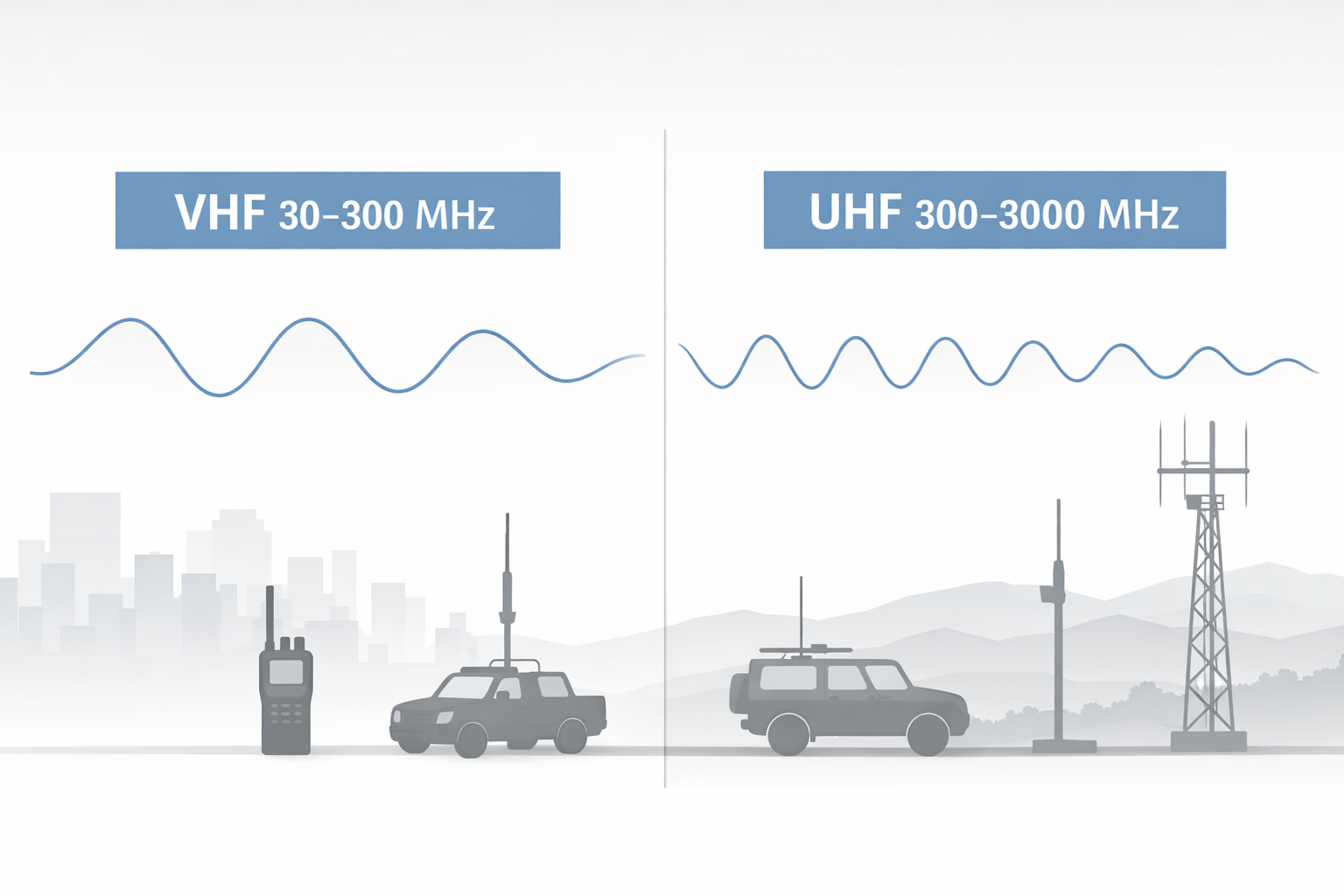
This case exposes a widespread misconception: frequency selection cannot focus solely on coverage distance; it must match the actual propagation environment. While VHF (30–300 MHz) and UHF (300–3000 MHz) differ by only one order of magnitude, their electromagnetic wave propagation behaviors are fundamentally different—this stems from the relationship between wavelength and obstacle dimensions.
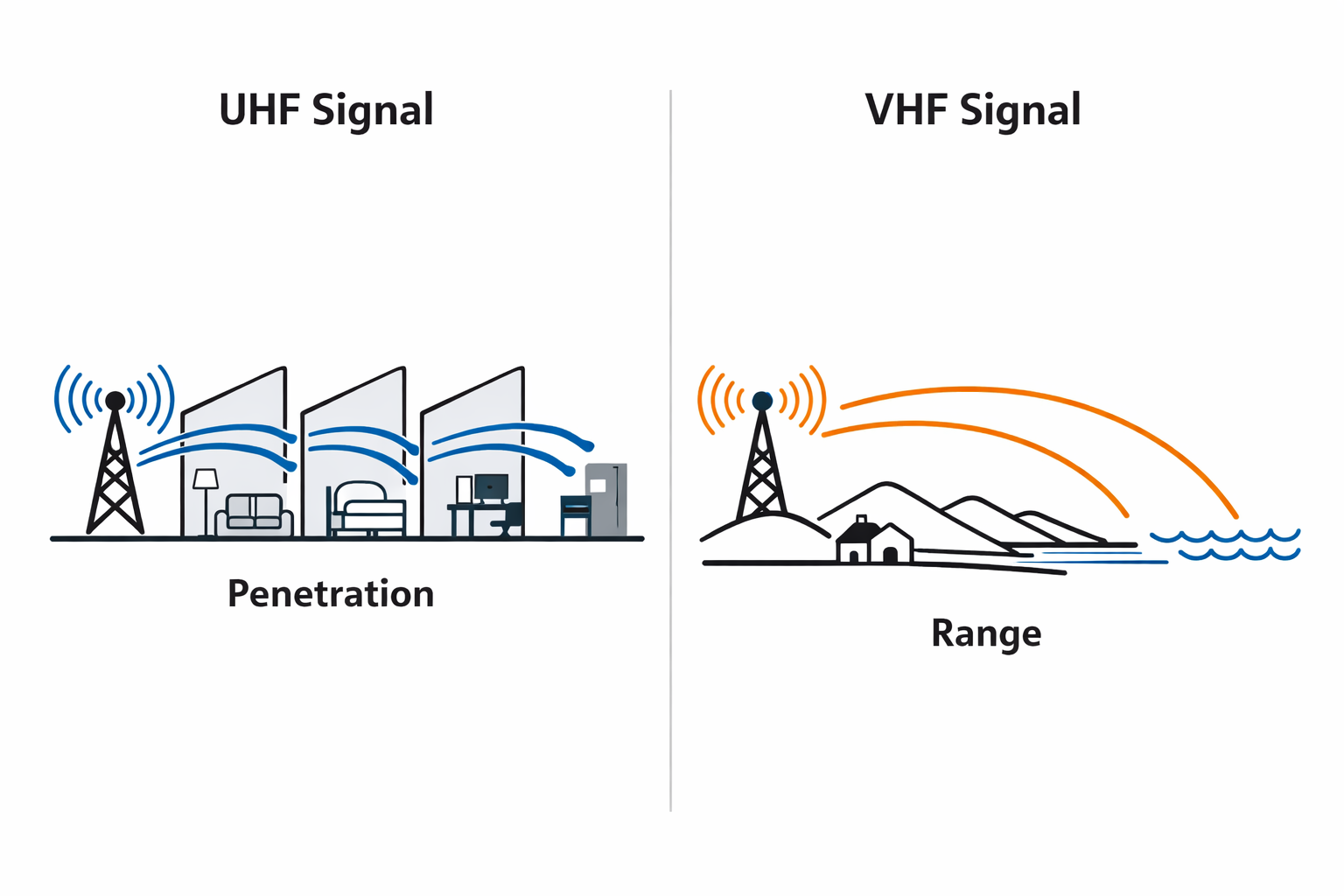
VHF wavelengths span 1–10 meters, providing excellent diffraction capability when encountering large obstacles like buildings or mountains, allowing signals to “bend around” obstructions and continue propagating. However, this longer wavelength struggles to penetrate reinforced concrete structures, becoming a liability in urban canyon effects. In contrast, UHF wavelengths range from 0.1–1 meters; though diffraction capability is weaker, building material penetration performance significantly exceeds VHF—which explains why indoor communication systems almost universally adopt UHF bands.
In ideal free-space environments (open water, flat grasslands, line-of-sight paths), VHF demonstrates clear propagation advantages. According to the Friis transmission equation, at identical transmit power, a VHF 150 MHz signal experiences approximately 9.5 dB less free-space path loss compared to UHF 450 MHz—equivalent to nearly tripling coverage distance.
Our 2022 deployment of a VHF 156 MHz system for a maritime client showed that 5W handheld devices achieved stable communication at 12–15 kilometers in open water field tests, while equivalent-power UHF systems covered only 8–10 kilometers. This is precisely why the International Maritime Organization (IMO) mandates VHF 156–174 MHz as the standard communication band for vessels.
When environments shift from open terrain to urban jungle, the situation completely reverses. Test data from a commercial complex in Zhengzhou, China demonstrates:
Reinforced Concrete Wall Penetration Loss:
VHF 150 MHz: 25–30 dB (signal nearly completely blocked)
UHF 450 MHz: 12–18 dB (maintains basic communication)
The physics behind this difference: when wavelength approaches obstacle internal structure dimensions (rebar spacing, wall thickness), resonant absorption effects occur. VHF’s longer wavelength more readily undergoes strong interactions with metallic building structures, causing substantial energy losses. UHF’s shorter wavelength can traverse microscopic pores in building materials with comparatively less attenuation.
A five-star hotel initially deployed a VHF intercom system, but experienced frequent communication failures between front desk and housekeeping, kitchen and dining areas. Technical team site surveys revealed the hotel utilized steel frame construction with lightweight partition walls; VHF signals attenuated over 40 dB after penetrating 3–4 wall layers, completely failing to meet operational requirements.
Solution: Replaced with a UHF 430–440 MHz system using 4W handheld devices, measured coverage performance:
2-wall penetration: signal strength -75 dBm (excellent)
4-wall penetration: signal strength -92 dBm (usable)
Elevator shafts: signal strength -85 dBm (good)
Post-deployment, communication dropout rates decreased from 35% to below 2%, fully satisfying operational needs.
In 2024, a provincial emergency management department deployed rescue communications in mountainous terrain, conducting comparative VHF and UHF solution testing. In non-line-of-sight environments with mountain obstructions, VHF’s diffraction capability demonstrated overwhelming superiority:
VHF 150 MHz handhelds: maintained communication 3–5 kilometers behind mountain masses
UHF 450 MHz handhelds: signal rapidly degraded after mountain obstruction, effective range under 1 kilometer
The final system adopted VHF band with mountaintop repeaters, achieving seamless regional coverage with equipment investment 40% lower than UHF alternatives.
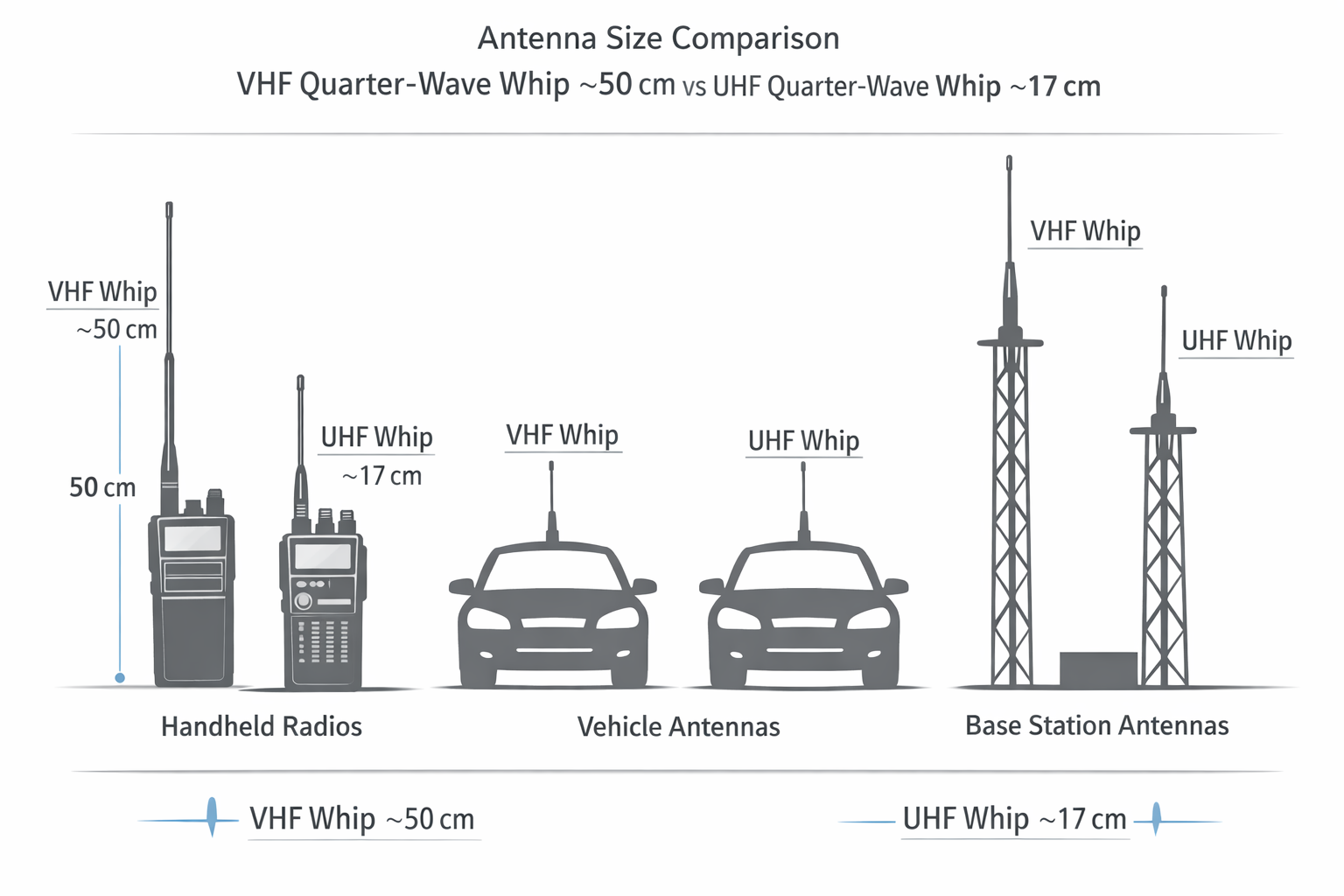
Frequency selection not only affects propagation but directly determines antenna physical dimensions and system integration complexity. Per antenna theory, typical 1/4 wavelength whip antenna lengths are:
VHF 150 MHz: approximately 50 cm
UHF 450 MHz: approximately 17 cm
This size differential produces dramatically different impacts across use cases. For handheld rubber antennas, UHF’s compact antenna means superior portability and durability—our long-term construction site usage testing found VHF handheld antenna damage rates exceeded UHF devices by over 3x. For vehicle-mounted antennas, while VHF’s longer antenna increases wind load and mechanical stress, performance advantages in open environments sufficiently compensate for these drawbacks.
More critical considerations involve installation space constraints. In a smart meter project, client requirements specified communication module integration within compact plastic housings; VHF antenna’s 50 cm length completely failed industrial design requirements, necessitating UHF solutions with ceramic patch antennas for miniaturization.
Beyond antenna size, frequency selection directly impacts device power consumption. UHF’s high-frequency characteristics require stronger transmission power to overcome free-space path loss, causing noticeably faster battery drain versus VHF.
Field Test Comparison (identical 5W output power handheld devices):
VHF 150 MHz devices: 18–22 hours per charge (moderate usage)
UHF 450 MHz devices: 12–16 hours per charge (identical conditions)
This differential produces significant impact in large-scale deployments. A property management company operating 200 security personnel all equipped with UHF handhelds. Due to insufficient battery life, they required two spare batteries per employee, increasing battery procurement costs alone by $8,800 USD. Had they initially selected VHF (equally viable in their open campus environment), spare battery requirements could have been halved.
Procurement Insight: If your application demands extended continuous operation (12+ hour shifts) and environment permits VHF, VHF’s battery advantage can substantially reduce operational costs.
Through hundreds of project implementations, we’ve developed a three-dimensional decision model.
VHF-Preferred Characteristics:
Open terrain comprises >70% (maritime, plains, airports)
Obstacles primarily natural terrain (hills, vegetation)
Communication distance requirements >15 kilometers
No indoor coverage requirements
UHF-Preferred Characteristics:
Dense building environments (cities, industrial parks)
Indoor communication exceeds 50% of use
Multi-story building penetration requirements
Communication distance requirements <10 kilometers
If systems include handheld portable devices, UHF’s miniaturization advantage typically becomes decisive—unless propagation environment strongly favors VHF (e.g., maritime applications). For fixed base station antennas or vehicle-mounted systems, antenna size impact diminishes, making propagation characteristics the dominant selection factor.
Civil aviation communications: must use VHF 118–137 MHz (ICAO Annex 10)
Maritime communications: must use VHF 156–174 MHz (SOLAS Convention)
Commercial land mobile radio: varies by jurisdiction, consult local spectrum authorities
Must Choose VHF (no viable alternatives):
Maritime communications (international regulatory mandate)
Civil aviation ground operations (industry standard)
Mountain rescue (requires diffraction coverage)
Open water coverage exceeding 20 km
Battery life-critical applications
Must Choose UHF:
Multi-story hotels/shopping centers (high penetration needs)
Steel-structure construction sites
Underground parking/tunnels
Handheld portable device-dominated deployments
Dense high-rise urban centers
Flexible Selection (recommend field testing):
Industrial parks (mixed open + indoor)
Fleet dispatch (urban + suburban mixed)
University campuses (balanced indoor/outdoor)
This is fundamentally incorrect. Frequency selection involves matching physical characteristics to application scenarios—neither is inherently “advanced” or “obsolete.” Globally, VHF remains the primary band for critical sectors like maritime and aviation, proving its irreplaceable value in specific environments.
Basic electromagnetic propagation principles state: higher frequencies incur greater free-space path loss. Under equivalent conditions, VHF theoretical coverage substantially exceeds UHF. However, actual system range also depends on transmit power, antenna gain, and receiver sensitivity—simple comparisons are misleading.
While theoretically possible, practical project realities show repeater construction costs, maintenance complexity, and regulatory approval processes often exceed expectations. Our experience: proper frequency selection can reduce repeater requirements by 50%+, dramatically impacting total cost and system reliability.
Simplest method: check device nameplate or specification label, which typically indicates operating frequency range. If labels are unclear:
Antenna length: handheld antenna >30 cm → likely VHF; <20 cm → likely UHF
Frequency display: 100–200 MHz = VHF, 400–500 MHz = UHF
Manufacturer lookup: query complete specifications via model number on official websites
Critical Reminder: When acquiring used equipment or inheriting legacy systems, always confirm frequency band first to avoid purchasing incompatible expansion equipment.
Overwhelming majority: No. Single-band devices only communicate within their respective bands; VHF equipment cannot receive UHF signals and vice versa.
Exceptions:
Dual-band devices (VHF + UHF) can switch between bands but cost 30–50% more
High-end public safety equipment supports multiple bands but carries premium pricing unsuitable for commercial applications
Practical Advice: If your team already operates VHF equipment, new acquisitions must continue with VHF unless planning complete system replacement. Mixing frequency bands creates communication silos.
Worth investing:
Work environments frequently alternate between open terrain and urban areas (e.g., surveying teams)
Requires interfacing with different client/partner systems
Mission-critical communications like emergency rescue (maximizes compatibility)
Not worth investing:
Work environment is singular and stable
Budget-constrained small teams
Clear single-band requirements already established
Cost Trade-off: Dual-band devices typically cost 1.3–1.5× single-band equivalents, but if avoiding duplicate system purchases, long-term economics favor dual-band.
Most reliable method: field testing, avoiding theoretical assumptions:
Rent test equipment: contact suppliers to rent one VHF and one UHF system for 3–7 day field trials in actual operating environments
Critical location testing: test at communication dead zones, penetration challenges, maximum range extremes
Document data: use signal strength meters for measurements rather than relying solely on subjective voice quality assessments
Simulate peak periods: test during actual working conditions with full personnel and equipment operation
Case Study: A shopping mall conducting pre-deployment rental testing discovered UHF signal severe attenuation at basement level 3, ultimately requiring two additional indoor repeaters to resolve. Skipping testing and purchasing directly would have incurred $11,700 USD in rework costs.
Based on years of antenna procurement and supply experience, we recommend buyers clearly specify:
Essential Technical Parameters:
Operating frequency band (precise MHz range, e.g., 450–470 MHz, not generic “UHF”)
Environment description (open/urban/indoor, obstacle types)
Coverage distance requirements (considering transmit power and receiver sensitivity)
Antenna form factor constraints (installation space, gain requirements, directionality)
Essential Documentation Requests:
Full-band VSWR curves (not single-point values)
Radiation pattern test reports (horizontal and vertical planes)
Gain vs frequency relationship curves
Third-party certifications (FCC, CE, SRRC, etc.)
Critical Note: Request suppliers provide field-measured data from typical installation scenarios rather than theoretical calculations. We’ve encountered too many cases of “beautiful datasheets, terrible field performance”—often because suppliers only provide ideal-environment simulation results.
As wireless communication technology evolves, single-band systems are progressing toward multi-band convergence. In a 2025 smart city project we participated in, VHF + UHF + LTE multi-mode terminals were deployed: automatically switching to VHF in open areas for maximum coverage, switching to UHF upon entering buildings for maintained penetration, and switching to a 5G antenna during emergencies for data transmission capability.
While such converged solutions cost 30–40% more than single-band alternatives, reliability improvements in complex environments exceed 95%—justified investment for mission-critical communications (emergency response, public safety).
UHF versus VHF selection fundamentally involves matching electromagnetic wave physics to real-world application scenarios. No universal frequency band exists—only optimal solutions for specific contexts. As antenna engineers, our recommendation:
Prioritize field surveys and signal testing during project planning phases, validating theoretical predictions with measured data—more reliable than any calculation model. Simultaneously, maintain system redundancy and expansion capacity for potential environmental changes or requirement upgrades.
Finally, if project budgets permit, consider dual-band (VHF + UHF) or multi-mode solutions as insurance against complex environments and uncertainties.
Contact: Diana Xie
Phone: 86-15815571536
E-mail: sales@global-antenna.com
Whatsapp:8615815571536
Add: Room826, Floor 8,BLDG 13, University Science Park(East), Zhengzhou City, P.R.Henan, China.Zip Code: 450000