Let’s be honest—if you’ve been running a fleet for more than a few months, you’ve already seen it. That little gray dot on the map stops moving, or worse, it jumps to a location that makes no sense. Your dispatcher starts texting you. The driver says everything’s fine. But the system? It's blind.
This isn't because you bought cheap trackers. GPS tracker signal loss happens to everyone. It's a physical limitation, not a brand problem. But here’s the good news: most of the time, you don’t need to throw away your hardware. You just need to understand why the signal disappears in the first place.
Let me walk you through the 7 real reasons I’ve seen kill GPS signals in commercial fleets. And yeah, I’ll also tell you the one hardware upgrade that actually fixes the majority of them.
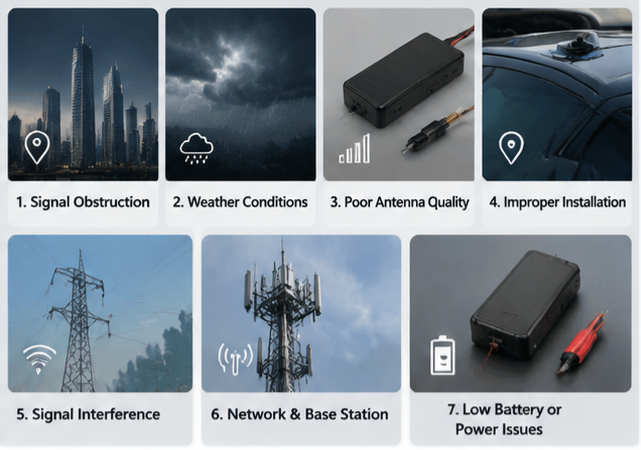
1. The "urban canyon" nightmare
You’ve got trucks going through downtown areas—tall glass buildings on both sides, narrow streets. The GPS signals bounce off those skyscrapers like pinballs. The tracker gets confused, gives wrong positions, or just gives up. This is the top complaint for last-mile delivery fleets. We call it the urban canyon effect.
2. Tunnels and parking garages? Forget it
Drive into a concrete warehouse or an underground garage, and the signal dies instantly. That’s physics. But what really hurts operations is when the tracker takes forever to wake up again after coming out. Sometimes 30 seconds, sometimes a full minute. And in that gap, you lose the real route.
3. Bad weather actually matters
I know it sounds cliché, but heavy rain, thick fog, or even dense cloud cover can knock down GPS signal strength by 20–30%. Water absorbs those frequencies. So on a stormy day, a tracker that’s already borderline will start dropping in and out.
4. The cheap internal antenna problem (this one's huge)
Most low-cost trackers come with a tiny ceramic patch antenna soldered right onto the board. No amplifier, no help. Then you mount the tracker under the dashboard or behind a steel panel, and boom – you’ve basically put your receiver inside a metal cage. The signal drops 40–70%. This is the #1 hidden cause of GPS tracker signal loss in fleets. Nobody talks about it because they want to sell you a new tracker instead.
5. That fancy heated windshield is blocking you
Modern trucks often have heated windshields or metallic UV tint. Those coatings act like a Faraday cage – they reflect GPS signals away. So if your tracker is sitting on the dash, it might as well be in a bunker.
6. Interference from other electronics
Dash cams, CB radios, cheap LED light bars – some of these emit noise right in the GPS frequency band (around 1.5GHz). The tracker can’t filter it out. It just sees noise and loses the real satellites.
7. Dirty power from the vehicle itself
Here’s one even experienced fleet managers miss. A failing alternator or noisy electrical system sends unstable voltage to the tracker. That electrical “dirt” reduces the tracker’s internal sensitivity. So even if you have a clear sky view, the device performs like it's half-deaf.
The one fix that actually works: an external GNSS antenna
Look, you can update firmware all day. You can reboot the tracker. You can pray to the satellite gods. But none of that will improve GPS accuracy if the antenna can’t hear the sky.
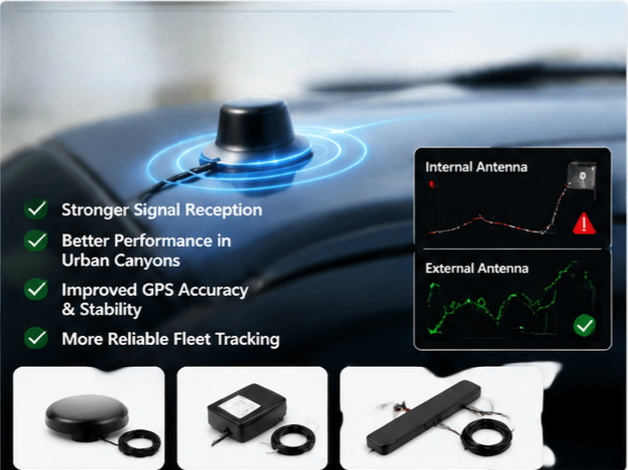
Here’s what does work: moving from that tiny internal patch to an external GNSS antenna for tracker.
Why? Two reasons.
First, an active external antenna has a built-in amplifier (called an LNA). It boosts the signal before the vehicle’s electrical noise gets mixed in.
Second – and this is the big one – you can put that antenna on the roof. Magnetic mount, five seconds of work. Suddenly the tracker sees the whole sky, not just what leaks through metal and glass.
I’ve seen fleets cut signal loss by 80% just by adding a decent GNSS antenna for tracker to their existing hardware. No need to replace every tracker. Just add the antenna.
So when you’re shopping for industrial solutions, don’t just look at the tracker itself. Look for units with an external antenna port (SMA or MCX). Pair them with a high-gain antenna – 28dB or more, with a SAW filter to block cellular interference. That’s how you solve a fleet tracking signal issue for good.
Quick fixes you can try today (no new hardware needed)
Before you buy anything, do these three things:
Move the tracker. If it’s under metal, put it on top of the dashboard. Not perfect, but better.
Check your cable length if you already use an external antenna. Keep it under 5 meters. Long thin cables kill signal.
Turn off other electronics temporarily – dash cam, radio, extra lights – and see if the signal improves. If yes, you’ve found your interference source.
But honestly? For fleets running in cities, forests, or any challenging environment, the real answer is external antennas. Cheap fix, massive improvement.
Bottom line
You don’t need spy gadgets or hidden devices. You need reliable hardware that works through concrete, rain, and traffic.
If you’re tired of watching your trucks disappear from the map every time they hit a downtown block or a storm rolls in, consider upgrading to industrial-grade GPS trackers paired with high-gain GNSS antennas. That’s how professional fleets eliminate signal loss complaints – not by hoping, but by fixing the physics.
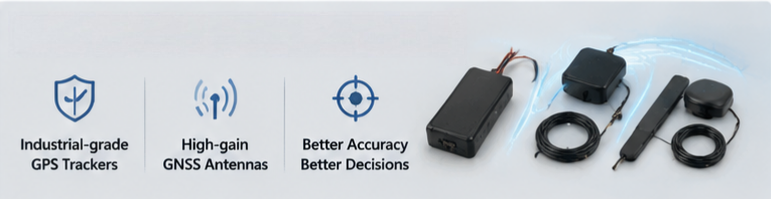
Need a real solution for your fleet? We supply rugged GPS trackers and GNSS antenna for tracker kits designed for 24/7 commercial use. Roof-mountable, IP67 waterproof, and built to last.
Contact: Diana Xie
Phone: 86-15815571536
E-mail: sales@global-antenna.com
Whatsapp:8615815571536
Add: Room826, Floor 8,BLDG 13, University Science Park(East), Zhengzhou City, P.R.Henan, China.Zip Code: 450000